Multi-Perspective Finger-Vein Biometrics
Links
- PDF Attachments: 2018’Multi-Perspective Finger-Vein Biometrics_Prommegger et al_.pdf
- Zotero Links: Local library
Contributions
- A new multi-perspective finger vein database is proposed and a corresponding imaging device. The number of perspectives is very large.
- A comprehensive evaluation of the recognition performance for finger-vein images taken from different perspectives.
- Further analyzed if a fusion of different views can improve the recognition performance of the system
Some descriptions
- The drawbacks of finger-vein based recognition systems include relatively big capturing devices compared to fingerprint sensors, images having low contrast and quality in general and that the vein structure may be influenced by temperature, physical activity and certain injuries and diseases
- It has been shown that finger- as well as hand-vein recognition systems are susceptible to spoofing [15, 14]. The proposed spoofing technique is based on a simple paper printout of the vein pattern. Capturing the vein images from different perspectives will prevent such simple kinds of spoofing attacks.
- The camera should be equipped with an NIR pass-through filter to block the ambient light and further enhance the image contrast.
Motivation
It is not clear if there are other perspectives that provides better or enough additional information to improve the performance of the recognition system.
Finger-Vein Recognition System
Hardware Device
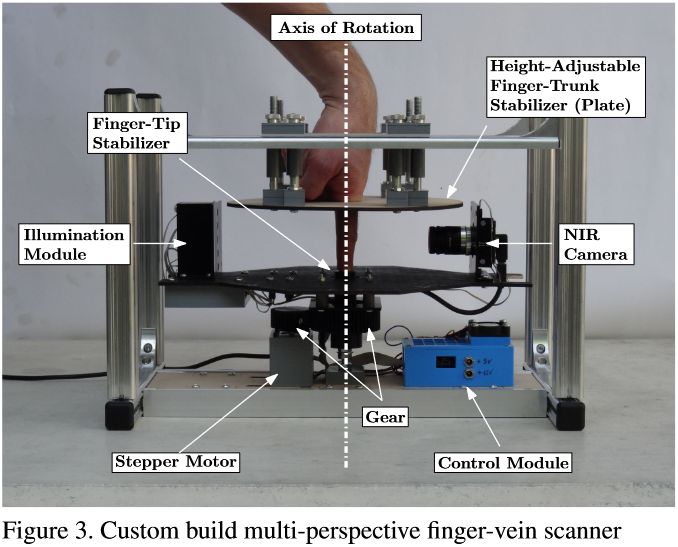
Principle: The finger is positioned at the axis of rotation, whereas the camera and the illumination module are placed on the opposite sides, rotating around the finger, i.e. the scanner is based on the transillumination principle. The rotation of camera and light source enables the scanner to acquire images from different views.
Two approaches to stabilize fingers: 1) For the fingertip, we constructed a part that has a finger-tip shaped hole. Putting the finger into this hole keeps it in its position. 2) For the hand we added a height-adjustable wooden plate. Placing the hand on this plate stabilizes the trunk of the finger. The height of the plate is adjusted according to the length of the captured finger.
Other Inforamtion: 1) 5 NIR laser diodes (808 nm) placed on a strip (The illumination intensity of each laser diode is controlled separately). 2) During data acquisition, the intensity of the different laser diodes is set automatically according to the contrast of the image. 3) A stepping monitor is used to control the rotation. 4) The automated illumination algorithm is introduced in Sec 3.1.
Acquisition process: The acquisition process is semi-automated. After the finger is put into the device and the capture process is initiated, the illumination for the finger is set automatically in order to achieve an optimal image contrast with the help of a contrast measure. After this, the video acquisition is started. To achieve a defined resolution (in degrees) of images (video frames), the speed of the rotation and the video frame rate are coordinated with each other. All perspectives are captured in one run using the same illumination conditions to ensure the comparability of the different projections.
ROI Extraction
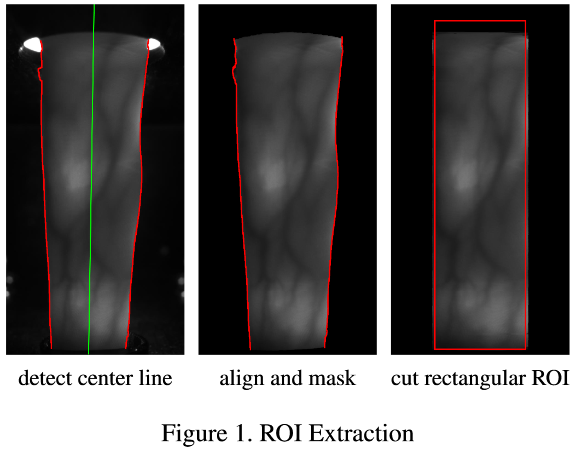
3 steps in this system
Preprocessing
CLAHE + High Frequency Emphasis Filtering (HFE)[23] + Circular Gabor Filter (CGF) [20] (More details can be found in [3])
Dataset
-
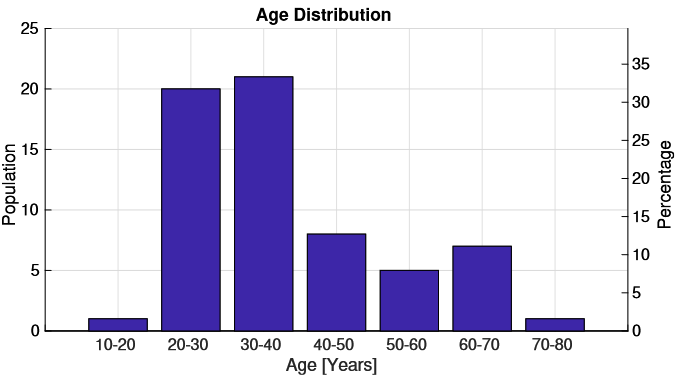
63 volunteers (27 females (43%), 36 males (57%)). The volunteers come from 11 different countries, and most of the volunteers are white Europeans (73%).
-
4 fingers per subject, index and middle of both hands.
-
252 classes in total.
-
5 times capture for each finger. (Each time removing the finger from the scanner and putting it in again.)
-
Resulting in
-
Image resolution:
-
Notions:
- 作者是采集的视频数据,每帧对应1°。理想情况应该是361帧,实际上是357-362帧,然后作者进行了换算
-
Age distribution
-
Examples
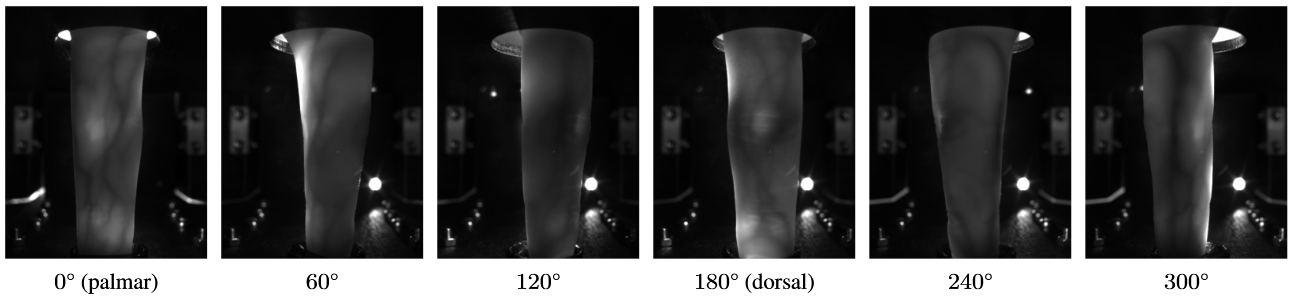
- It is apparent, that the number of visible veins in the images differ among the different projections.
Experiments
- Protocol: FVC2004[9]
- All genuine matches are calculated
- For imposter matches, only the first image of a finger is matched against the first image of other fingers.
- Baselines: LMC[11]、PC[2]、Gabor[5];SIFT[6]
- Metrics: EER, FMR100, FMR1000, ZeroFMR.
Recognition Performance of Different Perspectives
- Aim for analyzing the recognition performance from views all around the finger, we used 73 perspectives extracted in 5° steps.
- For every method there are two lines: the thin line shows the actual EER values of the relevant view, the thicker line is calculated from the EER values using a moving average filter of size 5 and should highlight the trend of the recognition performance.
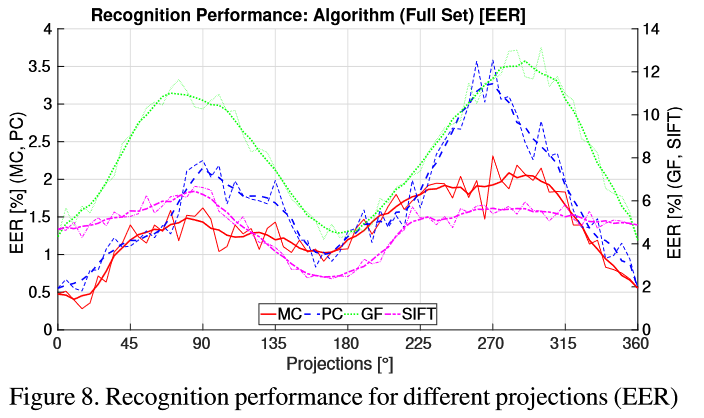 (Similar trends for FMR100, FMR1000, ZeroFMR.)
- Conclusions:
- The best results are obtained around the palmar (0°) and dorsal (180°) region. The inferior results of the perspectives between those two view can be explained by the fact that they contain fewer vein information
- It turns out that vein extraction - especially at 180° - compromises some features related with the knuckles of the finger. This features can be recognized as horizontal lines in the feature image.
- For SIFT, the best performance is achieved around the dorsal region. The structure of finger knuckles on the dorsal region provide more information for SIFT.
Opposing Views Recognition (Palmer and Dorsal)
- To ensure that two opposing views do not contain the same (just mirrored) information, we further investigated the palmar and dorsal perspective.
- We mirrored the images of the dorsal view along the longitudinal axis of the finger and matched them against the palmar ones. (将Palmer镜像,如果Palmer和Dorsal有相同的信息,那么就会被认定为同一类.)
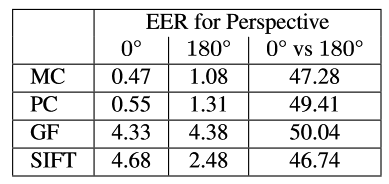
- Conclusion: The EER of all four used algorithms is close to 50% which means that the vein structure of the two perspectives is not related to each other
Score-level Fusion Multi-perspective Performance
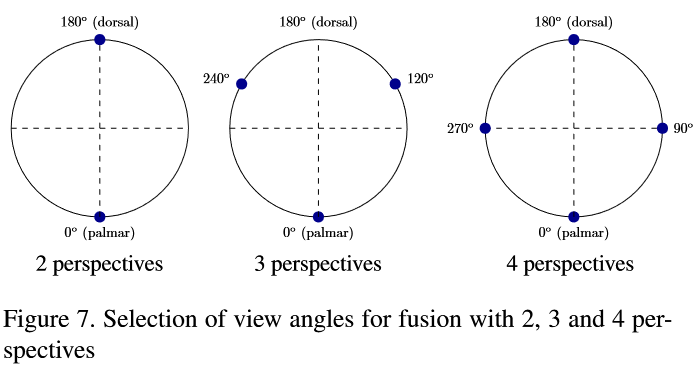
- We start with the fusion of two views and increase the number to the maximum of 72 views.
- The perspectives used are evenly distributed over the whole circle. 逐渐增大数量时,也是均分的应该
- 采用多个视角时的视角均分示意图
- 以0° (palmar view)为启动视角,增加视角数量的实验结果
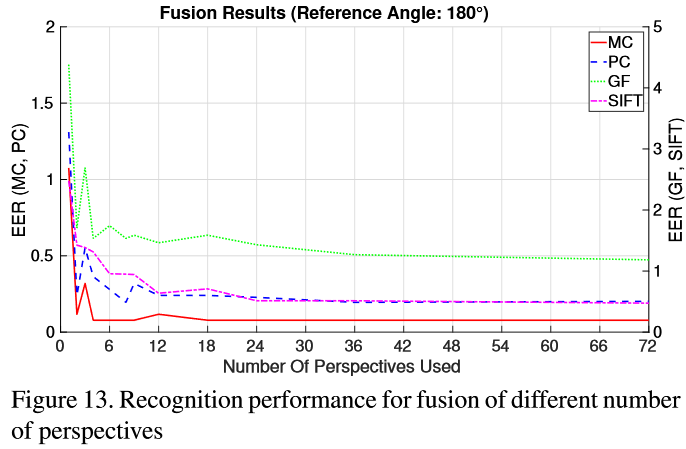
- Fusing the palmar with dorsal view improves the result. With the fusion of 3 views (60°, 180° and 300°), the result is slightly inferior to the one with two views.
- 以0° (palmar view), 45°, 90°, 180° (dorsal view) and 270°作为启动视角,增加视角数后的实验结果为
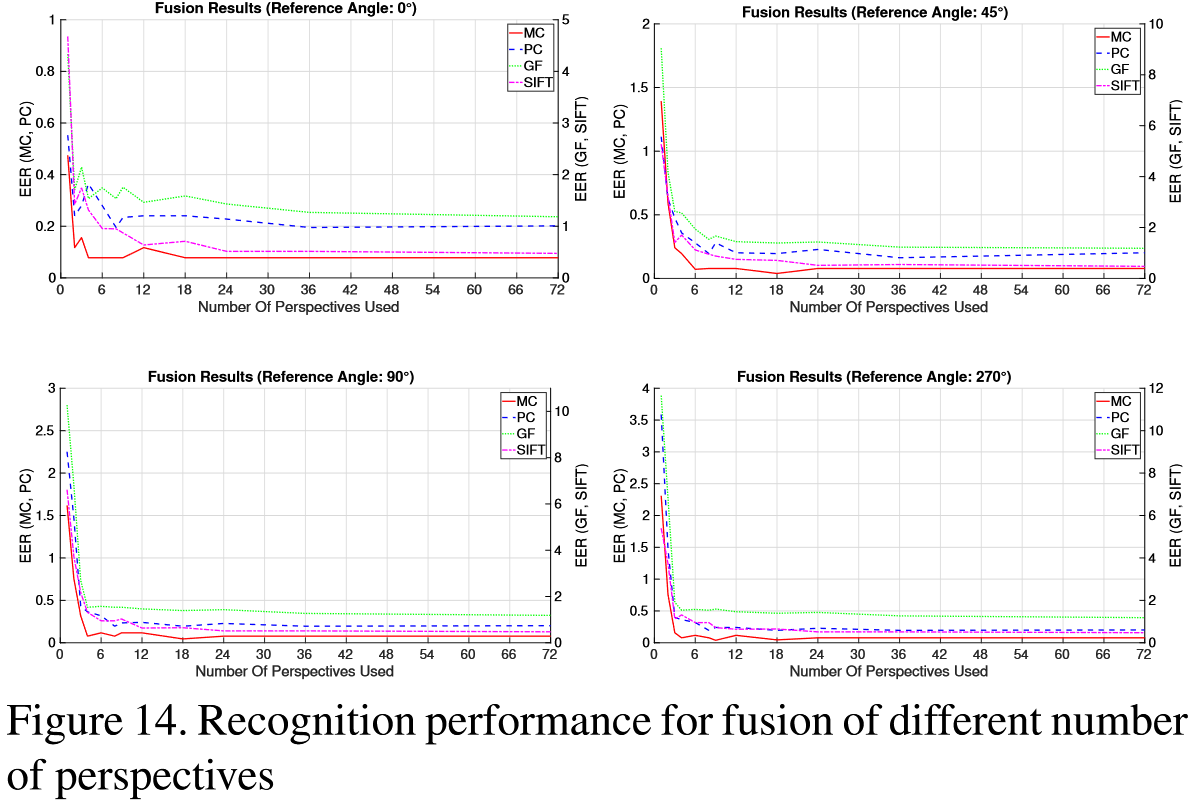
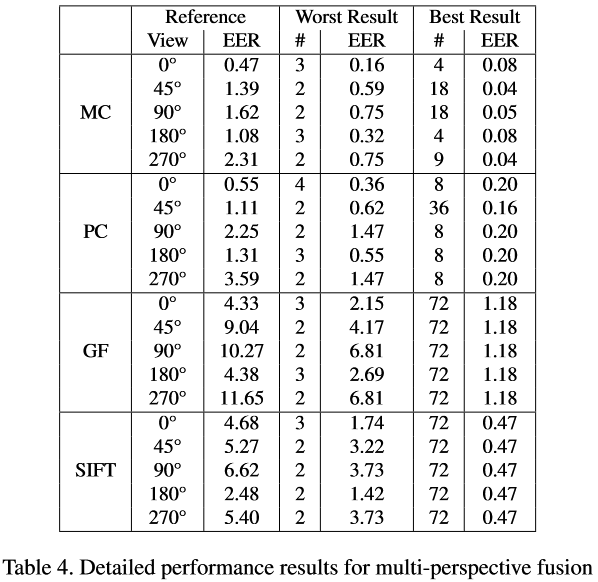
- 趋势和上一个实验基本是一样的,不在详细讨论
- 2-view-fusion (always fused opposing views, start from 0° and 270° )
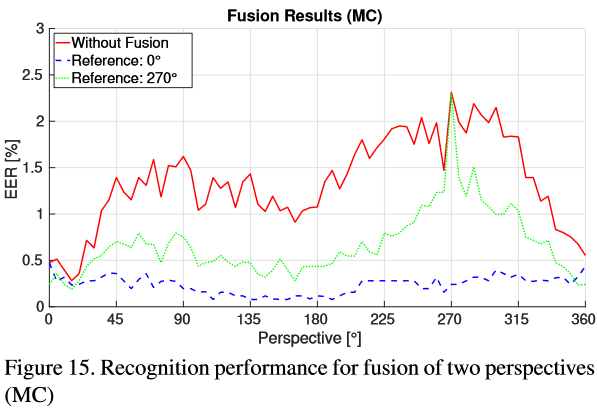
- PC, GF and SIFT (not visualized) show similar behavior。
- 作者发现,使用对侧的两个视图融合不一定得到好的结果(相比于单视角)
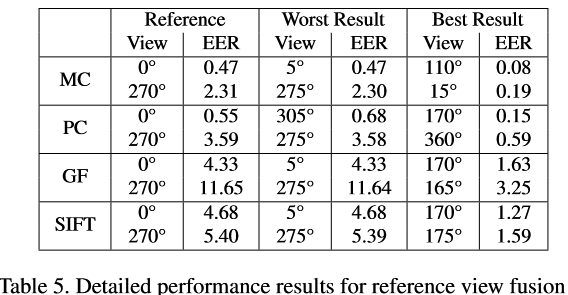 上图中Reference表示单视角,右边的视角都是对应角度的视角融合对侧的视角得到的结果。
 - The fusion of two opposite views achieves is already sufficient to achieve superior results compared to a single-view evaluation.