An Image is Worth 16x16 Words: Transformers for Image Recognition at Scale
Links
- PDF Attachments: 2021’An Image is Worth 16x16 Words_Dosovitskiy et al_.pdf
- Zotero Links: Local library
My Comments and Inspiration
- Transformer 在小数据集上的表现不好,原因是 Transformer 并没有 CNN 中的 inductive bias,而为了弥补这个差距,需要在大数据集上进行训练。
- 本文采用的是 naive 的 Transformer,希望能够以最少的改动(with the fewest possible modifications)将 Transformer 应用于 CV 上。
Cores, Contributions and Conclusions
Cores:
- 以最少的改动将 Transformer 应用于 CV 上
- 图像切 patch 后直接暴力拉伸
- 引入 position embedding 保留空间信息,以及引入 class token 作为分类用的 vector(或许可以视为 feature?) Contribution:
- 第一次以最少的改动将 Transformer 成功地应用于 CV 上,并取得了很好的结果。
- 此外,指出未来Transformer的发展前景,实验中给出了大量有效并且可靠的Transformer的性质的实验探讨。
Conclusion: 这里只列出部分重要的实验结论,其他更多的实验结论参考原文。
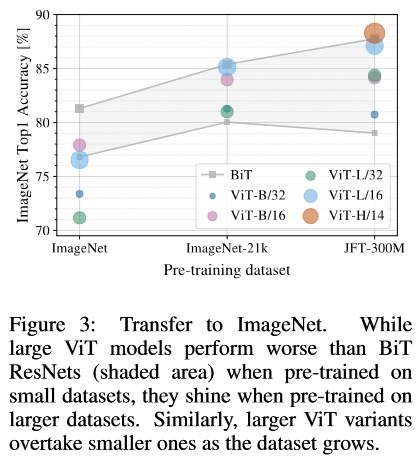
- 差不多参数量的 ResNet 和 ViT,在中等的数据库上(i. e., ImageNet),ViT 的效果会差一点。原因是 ViT 中缺少 inductive bias。相反的,在大数据库上(ImageNet-21k dataset or the in-house JFT-300M dataset)的表现,ViT 要比 ResNet 好。
- 由于缺少Inductive bias,ViT需要大量的数据来学习弥补这个缺陷。(We find that large scale training trumps inductive bias.)
ViT 的特点,同样是 Transformer 的特点
- 可以接受任意长度的 sequence 输入,仅受限于显存
- ViT的输入序列长度受到patch的大小影响,patch越小则序列长度越长,这会导致更大的计算量
Motivation
- 纵观 NLP 领域,随着模型和数据量的增大,Transformer 的表现并没有趋于饱和的情况,这给了作者将其在 CV 上进行进一步探索的动力。
- 彼时,虽然CV中有了一些引入了self-attention的工作,但是大部分都是将部分模块替换成self-attention模块。这类模型虽然高效,但是由于混合结构和特殊的注意力模块的存在,并不能很好的在硬件上进行加速。
Intro & Review
Methods
本作的核心是:以最小的改动,将 Transformer 应用到 CV 上
关于 Transformer 的一些预备知识:
- Transformer 中所有的 latent vector 的长度都是
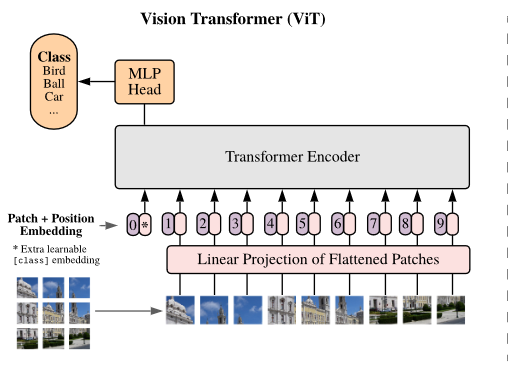
在尽量少改动 Transformer 的前提下,主要就是对图像数据进行处理,主要的流程为
- 对图像 切 patch,并将每个 patch 拉伸 (flatten) 成一维的向量, 。其中, 表示 patch 的边长, 表示 patch 的个数
- 对每个 , 首先经过一个 MLP 使其变成长度为 D 的 embedding,即
- 引入 class token ()以及表示 patch 空间位置的 posing embedding (),构建 Transformer 的第一层输入 ,有 其中,, , 我们上面提到了,是图像中 patch 的个数。
如何构建 class token? class token 初始化为一个可学习的嵌入向量。翻译成人话,在代码中只要初始化成一个可以学习的向量参数即可
self.cls_token = nn.Parameter(torch.randn(1, 1, D))如何构建 pos embedding?
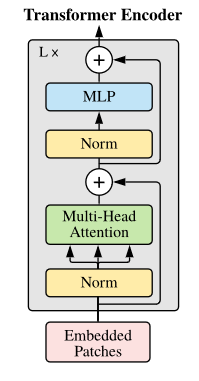
对于 Transformer 中的任意一层,我们有如下 forward function
 其中 MSA 表示多头注意力模块 (multi head attention), LN 表示 layer norm, MLP 就是全连接层,激活参数使用 GELU
对于最后一层 L 的输出,直接通过一个 LN 得到预测结果
How to pre-train ViT and fine-tune to smaller downstram tasks?
- Remove the pre-trained prediction head
- Attach a zero-initializaed feedforward layer, where K is the number of downstream classes.
How to fine-tune ViT to higher-resolution tasks?
- Keep the patch size the same, resulting in a larger sequence length (in this case, N becomes large).
- Since the pre-trained position embedding fails, 2D interpolation is performed to the pre-trained position embeddings.
Experiments
Setup
Dataset
Model
- ViT 的模型设置
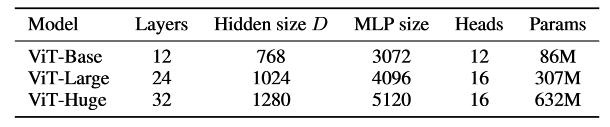
- 其中 ViT-Base 和 ViT-Large 直接从 BERT 里拿的
- 后面跟着数字 /16 表示 ViT 的输入 Patch 大小
-
ResNet 的模型设置
- 将所有的 BN 层换成 GN 层
- 使用 standardized convolutions → 参考, 不是标准卷积
- 标记为 ResNet (BiT)
-
混合模型 (hybrid model)
Traning & Fine-tune
Training
- Adam with
- bs = 4096
- a high weight decay of 0.1, use a linear learning rate warmup and decay
Fine-tuning
- SGD with momentum
- bs = 512
- fine-tune at higher resolution: 512 for ViT-L/16 and 518 for ViT-H/14, and also used averaging with a factor of 0.9999
多大的数据量能够弥补 Transformer 缺少 Inductive bias 的缺点?
- 在 3 个递增的数据库上进行 Pretrain:ImageNet, ImageNet-21K, JFT-300M,然后在下游任务上进行 Finetune
- 采用三个正则化方法:weight decay, dropout, label smoothing
- 利用 JFT-300M 的数据库构建 4 个递增的子数据库:9M, 30M, 90M, Full JFT-300.
- 没有正则化措施,但是超参都是一样的
This way, we assess the intrinsic model properties, and not the effect of regularization.
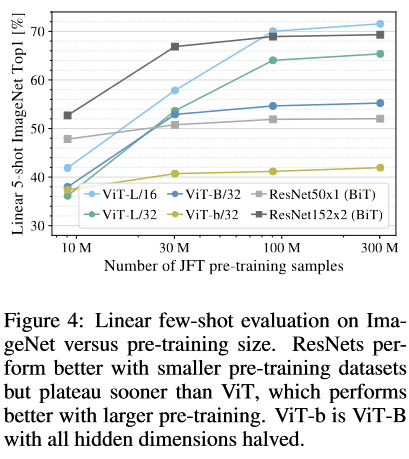
结论:
- 在差不多的计算代价下(comparable computational cost),ViT 相比于 ResNets 更容易在小数据库上过拟合
- 在小的数据库上,CNN 提供的 inductive bias 是十分有效的,此时 ViT 效果会差一些;但是对于大的数据库,ViT 是可以直接从数据中学习到相应的 pattern 的,甚至此时效果会比带有 inductive bias 的 CNN 效果更好。
ViT, CNN 和 Hybrid 模型计算量和表现的关系
- Pretrain on JFT-300M,此时,数据量不是限制模型表现的瓶颈
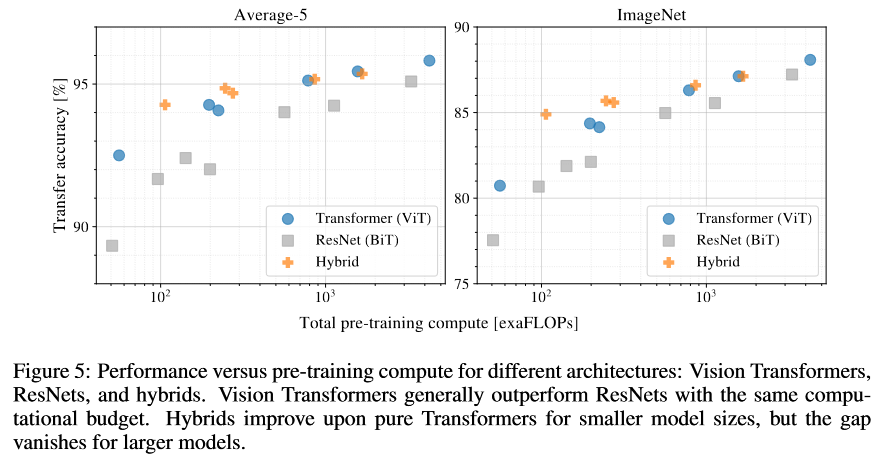
结论
- FLOPs 差不多的时候,ViT 表现比 ResNet 好(注意前提是数据量是足够的)
ViT uses approximately 2 − 4× less compute to attain the same performance (average over 5 datasets).
- 当计算量较小的时候,Hybrid 结构的表现要比 CNN 和 ViT 的好;但是当计算量大到一定程度时,这种差异就会变小甚至消失
This means that convolutional local feature processing to assist ViT at any size.
- ViT 似乎没有在图示的计算量范围内饱和,这也许意味着 ViT 有更多的潜力没有被挖掘出来。(但是似乎从曲线上看,ResNet 也是如此…)
探究 ViT 是如何理解/学习图像的
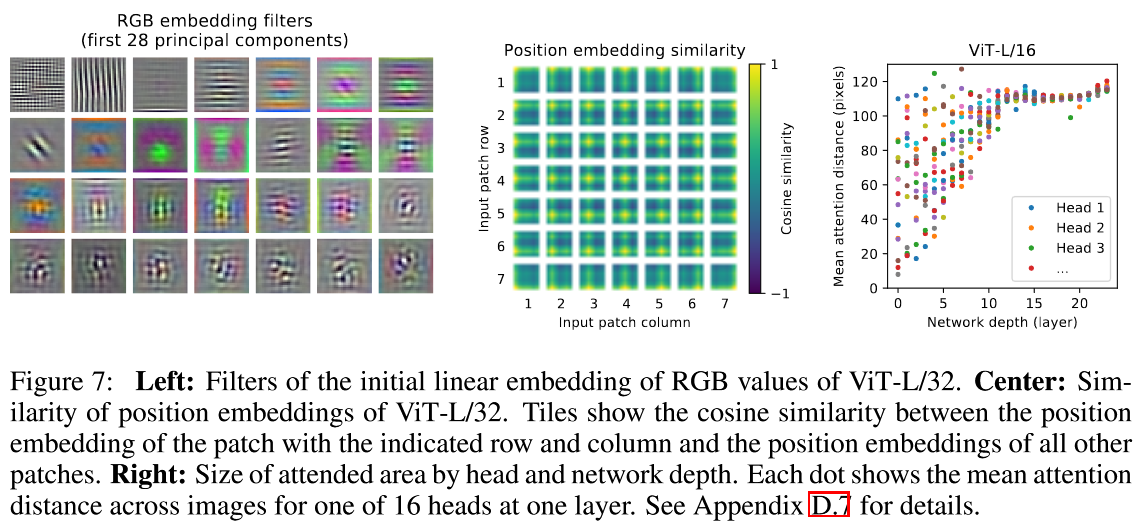
-
将第一层线性映射层 (即 ) 滤波器的主成分进行可视化(上图左)
[! 结论]- 这些组件有点类似每个 patch 中用于精细化结构低维表示的
The components resemble plausible basis functions for a low-dimensional representation of the fine structure within each patch.)
-
计算不同 patch 的 position embedding 的余弦相似性,并将其可可视化(上图中)
[! 结论]-
- 空间上越近的 patch ,它们的 position embedding 越相似
- 具有明显的 “行-列” 结构:同一行或者同一列的 patch 有相似的 position embedding
-
根据注意力权重计算图像空间中整合的信息的平均距离,并将其根据所在网络深度进行可视化(上图右)
[! 结论]-
- 这里的 attention distance 类似于 CNN 中的感受野
- 在 ViT 的浅层里, attention distance 有小有大,这说明已经有一些 head 在浅层时已经可以关注到全局信息,同时有一些 head 关注局部信息
- 在 ResNet + Transformer 的混合结构的浅层中,那些高度关注局部信息的 head 并不是很重要,这说明它与 CNN 结构中浅层卷积层有着类似的功能(关注局部信息)
- 随着网络的加深,attention distance 也变大,这说明在 ViT 的深层,更多的 head 关注于全局信息的整合。
ViT 在自监督任务上的表现
暂略。