LFMB-3DFB: A Large-scale Finger Multi-Biometric Database and Benchmark for 3D Finger Biometrics
Links
- PDF Attachments: 2021’LFMB-3DFB_Yang et al_.pdf
- Zotero Links: Local library
Contributions
- LFMB-3DFB is the first 3D finger multi-biometric database with multi-view, multi-spectral finger images and 3D finger model with skin and vein textrues.
- A corresponding multi-view, multi-spectral finger imaging device is designed.
- LFMB-3DFB contains multi-type finger data. For example, raw 2D images (vein and skin), reconstruction 3D finger model with skin and vein textures.
Some description
- The author called “dorsal side and ventral side” of the finger.
- Finger vein is internal feature and skin is external feature.
- Multi-camera system to surround the finger with blue and near-infrared light sources to irradiate the finger alternately.
Motivation
- Single modality tends to have unsatisfactory performance and is vulnerabel to be forged.
- The combination of all the traits on the finger and restore to a 3D representation identifical can tackle above problems.
Challenges
- How to acquire all the physiological traits from the finger and reconstruct the 3D fingre model.
- How to extract highly difcriminative identity features from this 3D holographic finger biometric trait.
Imaging System
- The author called it as The multi-view and mulit-spectral 3D finger imaging system.
- Pictures
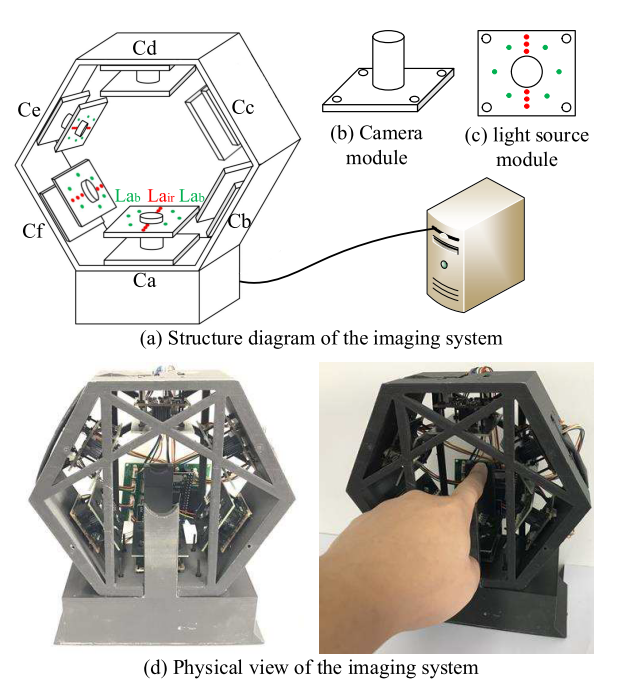 上图中红色的点是LED,绿色的点是Blue source light.
- 采集流程:
- 由STM32进行逻辑控制
- 6个摄像头逐一激活(可以同时采集可见光和NIR)
- 采集finger skin图像时,除了激活摄像头对侧的blue light不打开,其余的都lit,为了避免过曝同时保证光照均匀。此时所有LED都不开
- 采集finger vein图像时,仅激活摄像头对侧的LED lit,其余的灯都不开。
- 其他处理
- 图像内外参校准,内参使用棋盘格[21]和[15]校准外参
- 手指边界分割:采用Crose to fine的方式。先利用 Canny edge detection, K-means segmentation and multiscale segmentation with guided filter做分割;再利用logical operations and morphological methods对上述三个结果做融合,其结果为粗分割结果。利用这个粗分割的结果作为pseudo-label训练U-net[12],将训练好的Unet推理结果用作最终分割结果。作者说得到了很好的分割表现。
LFMB-3DFB Information

- Description
- Totally, 174 volunteers were collected. The index and middle fingers of both hands are captured.
- Colloect in one session.
- For each finger, 6 views with an interval of 30 degree were collected. And each view captured 10 times (10 for vein images, 10 for skin images). As a result, each finger has 60 images in each modality (vein, skin).
- Also, there are 6,950 3D finger mesh models in this database. (The reconstruction process are detailed in Sec 3.)
- Raw picture resolution is 1280x800 pixels.
- Insight:
- Contain 3D finger models with vein and skin textures, even if it is reconstructed by themselives.
- Large scale. (41,700 vein images, 41,700 skin images and 6,950 3D models.)
- Contain multi-type fingre traits, such as veins, fingerprint, finger kunckle, fingernail。
- **Drawback**:
	- One session captured, which can not ensure the robustness of the trait and the imaging system.
	- There is a big gap between the number of men and women (about 2:1)
	- From the results, maybe the dataset for multi-view recognition task is too easy?
Experiments
作者这里的实验主要是找几个Baseline,然后比较vein (Ve)、skin (Sk)、geometry information (Ge, point cloud without vein and skin texture.), SLF (score-level fusion of 6 views.)在对应的baseline上的表现,即主要看了看不同类型特征的可区分性。
Evaluation Metrics
- Identification: mAP, Rank-1 acc, Rank-5 acc, CMC (Cumulative Characteristic) curve.
- Verification: ROC, EER, TAR@FAR=0.01, TAR@FAR=0.001.
Baseline methods
- Single-view baseline: MobileNetV2[13].
- Multi-view baseline: MVCNN
- 3D End-to-end recognitin baseline: PoinNet and DGCNN
- Score-level fusion (SLF) recognition baseline: score fusion based on SVM.
Results
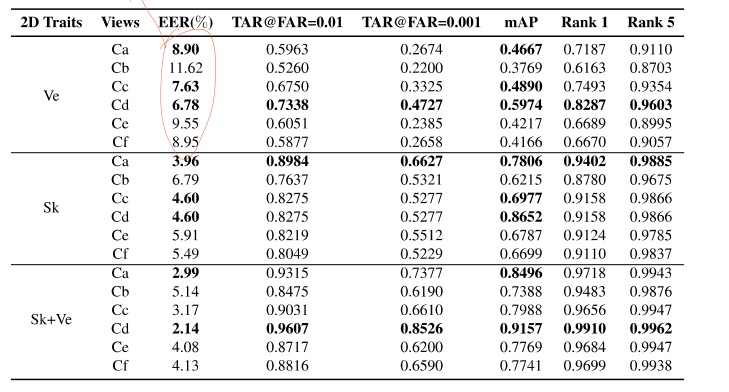
- Single-view recognition
- Results (Ca~Cf representas differeant cameras)
- My obsevation
- The traits under view Ca (finger ventral) and Cd (finger dorsal) is the most discriminative.
- Why skin trait is more discriminative than vein trait? Is that means FKP more discriminative? Or is FKP provides more discriminative power?
- Note that the rank-1 and rank-5 acc do nor reach 1 in single-view identification.
- Fusion is the best.
- Results (Ca~Cf representas differeant cameras)
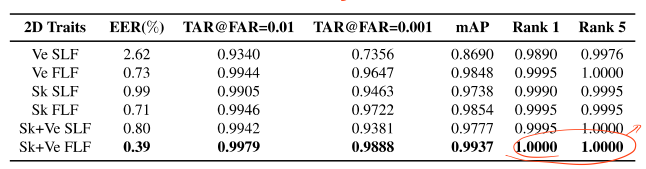
- Multi-view Recognitin
- Results
- My observation:
- Fusion is the best.
- Skin train is better than vein trait.
- vein and skin trait are both have good performance on Rank-1. Is that means this dataset have no research value on recognition or is too easy? Or we can say the difference may too small?
- In my opinion, it is a good database for the reseach of 3D finger vein reconstruction.
- Results
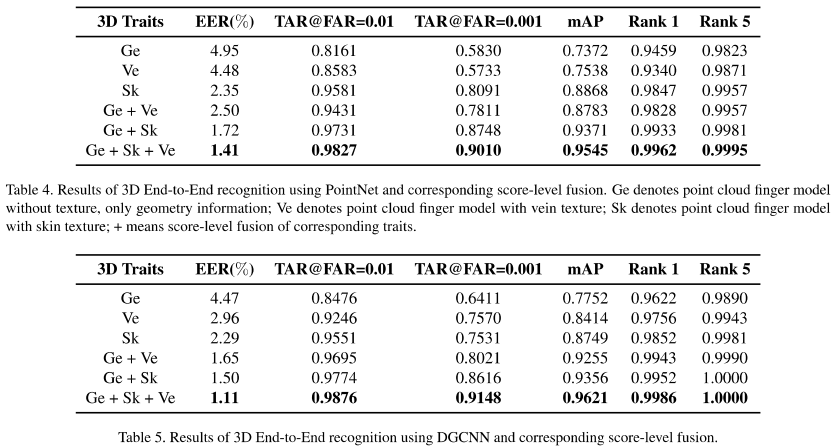
- 3D End-to-end recognition
- Results
- My obsevation:
- DGCNN is better than PointNet
- The self-reconstructed 3D finger model is indiscriminative than multi-view.
- Ge information is discriminative to some degree. The rank 1 and 5 acc are not small.
- The 3D finger vein reconstruction is need to improve.
- Results