ArcVein-Arccosine Center Loss for Finger Vein Verification
Links
- PDF Attachments: 2021’ArcVein-Arccosine Center Loss for Finger Vein Verification_Hou,Yan_.pdf
- Zotero Links: Local library
My Comments and Inspiration
This work seems like a combination of ECA-Net+ResNet as backbone. The most “novel” idea is replacing the Euclidean distance in center loss with cosine distance. The motivation and inspiration are not described clearly.
In addition, I question the authenticity of the results. The whole paper is in a bad organization. It is hard to follow, where the spelling errors, capitalization errors are very much.
Contributions and Important Conclusions
The author proposed a new loss function, which replaces the Euclidean distance in center loss with cosine distance.
The author claimed that this Arccenter is are easy to convergency and stable during traning.
Motivation
Not clear. The author only want to improve the performance.
Motivated by center loss and cosine distance (…Orz)
Methods
Introduce from two parts: feature extraction (network) and loss function
Feature extraction
The combination of ECA-Net and ResNet (Res block)
Input: Input images is with . They expand the one-channel gray images to three-channels by copying.
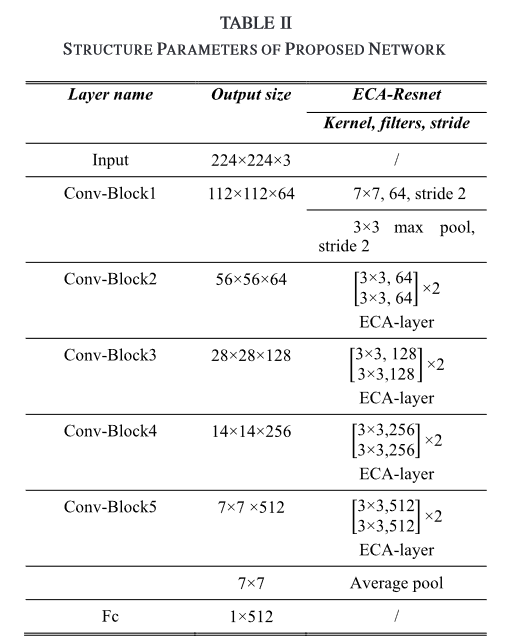
Architecture:
Defination of basicBlcok
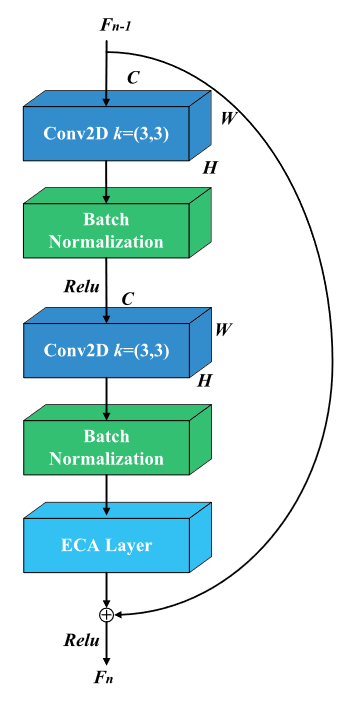
There are five basicBlocks with a Average pooling at the end.

Loss Function
A combination of Softmax Loss and Arccenter loss , formulated as
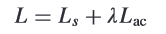
As experiment IV-C, the paremeter set as: USM = 0.5, POLY and SDU = 1, self-collected database = 2.
Arccenter: Just replace the Euclidean distance with cosine distance, i.e., original center loss:
Replace the Euclidean distance with cosine distance, we can obtain
where
Experiments
Database information
4 database are used.
SDU and self-collected database: randomly selected half images for training, the other for testing.
USM and POLY: session 1 for training and session 2 for testing.
ROI extraction is based on this paper.
P. Gupta and P. Gupta, “An accurate finger vein based verification system,” Digit. Signal Process., vol. 38, pp. 43–52, Mar. 2015.
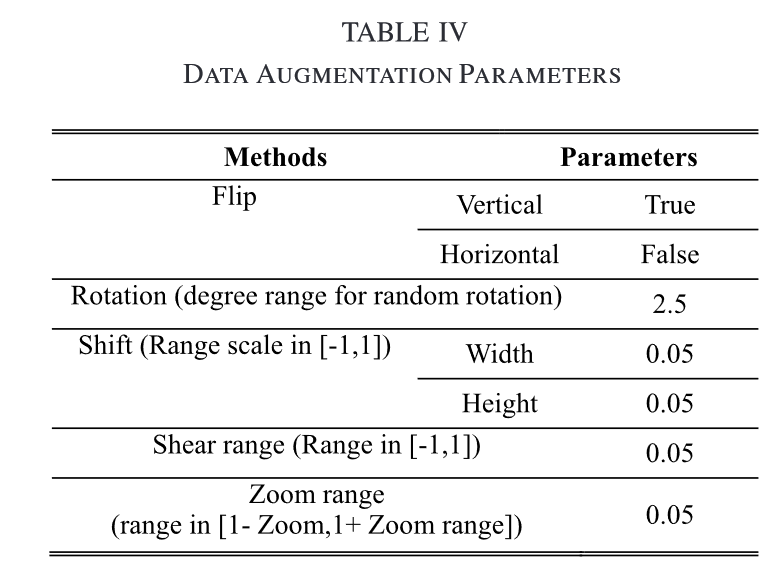
Data Augmentation
Online data augmentation, see following table.
Implement details
-
Optimizer: stochastic gradient descent algorithm with Nesterov momentum 0.9
-
LR: 0.01, divided by 10 after 30 epochs.
-
L2 wright deacy:
-
bs: 64
-
epochs: 100
-
Two-fold cross-validation.
Protocol
-
Closed-set protocol:
-
Open-set Protocol:
- For all databases, one-half of classes are selected for traning (maybe all samples are used), the other classes for testing.