Leetcode Link: 77. 组合 - 力扣(LeetCode)
题目
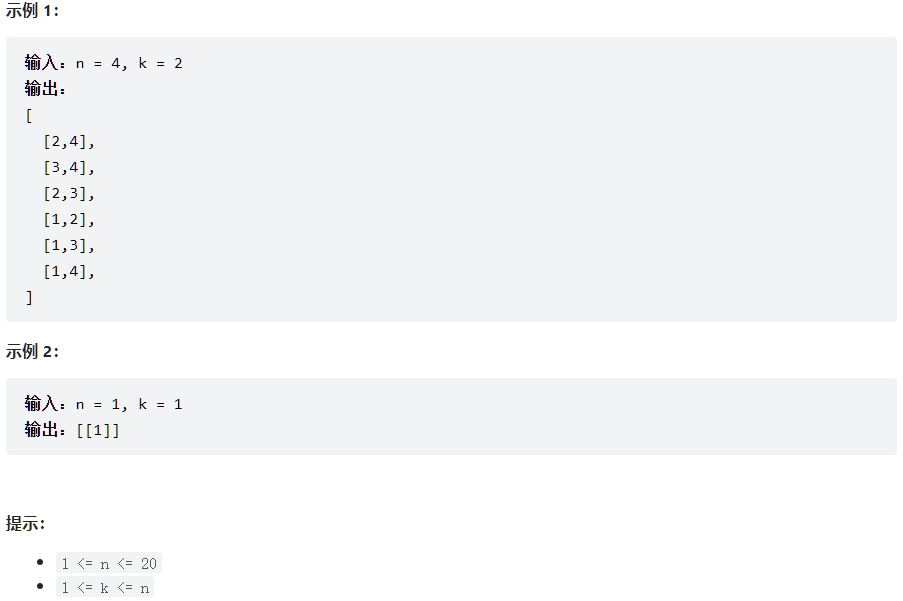
给定两个整数 n 和 k,返回范围 [1, n] 中所有可能的 k 个数的组合。
你可以按 任何顺序 返回答案。
组合,是不考虑顺序的,即[1, 2]和[2, 1]是一样的
解法一
思路:自己的思路 每次回溯的时候都给出一个choose。
题解:
class Solution:
    def combine(self, n: int, k: int) -> List[List[int]]:
        def backtracking(choose):
            nonlocal k, path, res
            # 返回条件
            if len(path) == k:
                # 这里必需使用deepcopy
                res.append(copy.deepcopy(path))
                return

            for idx, val in enumerate(choose):
                path.append(val)
                backtracking(choose[idx+1:])
                path.pop()

        res = [] # 这里不可使用 res = path = [],会导致两者同时变化
        path = []
        choose = [x for x in range(1,  n+1)]
        backtracking(choose)
        return res
考虑剪枝,当当前的path和剩余的选择加起来也不够k个元素的时候,后面就不用看了
class Solution:
    def combine(self, n: int, k: int) -> List[List[int]]:
        def backtracking(choose):
            nonlocal k, path, res
            # 返回条件
            if len(path) == k:
                # 这里必需使用deepcopy
                res.append(copy.deepcopy(path))
                return

            for idx, val in enumerate(choose):
                path.append(val)
                # 剪枝, 不能放在 for 的第一句,会丢val元素
                if len(path) + len(choose[idx+1:]) < k:
                    path.pop() # 必需记得po出来
                    return
                backtracking(choose[idx+1:])
                path.pop()

        res = [] # 这里不可使用 res = path = [],会导致两者同时变化
        path = []
        choose = [x for x in range(1,  n+1)]
        backtracking(choose)
        return res
解法二
思路:其他人的解法,不用每次都给出一个choose,直接给一个索引,然后在 nonlocal 的数组中直接确定choose区间
题解:
class Solution:
    def combine(self, n: int, k: int) -> List[List[int]]:
        res = []
        path = []
        def backtrack(n, k, StartIndex):
            if len(path) == k:
                res.append(path[:])
                return
            for i in range(StartIndex, n + 1):
                path.append(i)
                backtrack(n, k, i+1)
                path.pop()
        backtrack(n, k, 1)
        return res