Leetcode Link: 279. 完全平方数 - 力扣(LeetCode)
题目
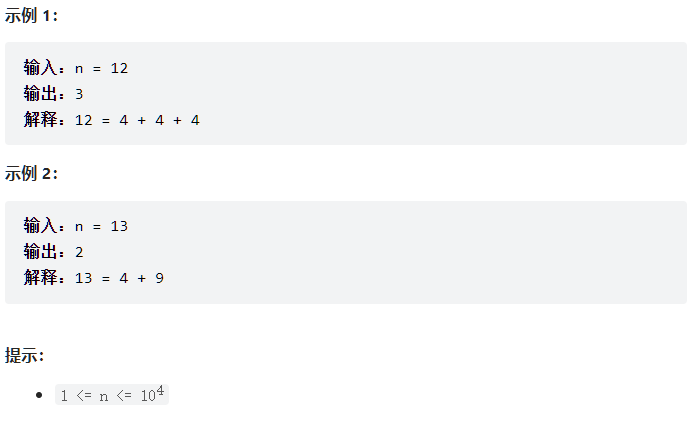
给你一个整数 n ,返回 和为 n 的完全平方数的最少数量 。
完全平方数 是一个整数,其值等于另一个整数的平方;换句话说,其值等于一个整数自乘的积。例如,1、4、9 和 16 都是完全平方数,而 3 和 11 不是。
解法一
思路:暴力递归
这个比较简单,就是不停的往下尝试
定义函数 def process(tar),返回和为 tar 的完全平方数的最少数量。
细节:
- 注意遍历的时候,不能从 0 开始,不然爆栈
- 遍历时,我们其实可以提前指定遍历的最大值,为
int(sqrt(tar)),并且这个值是可以取到的。
题解:
class Solution:
    def numSquares(self, n: int) -> int:

        @cache
        def process(tar):
            if tar == 0: # base case
                return 0

            res = float('inf')
            for i in range(1, int(sqrt(tar))+1): # 注意两边,最后要+1,以取到int(sqrt(tar))
                res = min(res, process(tar-i**2)+1)
            return res

        return process(n)
解法二
思路: 改写解法一为动态规划,直接抄就行
题解:
class Solution:
    def numSquares(self, n: int) -> int:
        dp = [0] * (n+1)
        # 初始化条件就是dp[0] = 0
        for tar in range(1, n+1):
            res = float('inf')
            for i in range(1, int(sqrt(tar))+1):
                res = min(res, dp[tar-i**2]+1)
            dp[tar] = res
        return dp[n]
复习时写的会超时的动规
class Solution:
    def numSquares(self, n: int) -> int:
        length = int(sqrt(n))+1 # 最大用的数字

        @cache
        def process(i, tar):
            nonlocal length
            if tar == 0:
                return 0
            times = 0 # 用多少次
            res = float('inf')
            ii = i**2
            while(tar-times*ii>=0 and i+1<=length):
                res = min(res, process(i+1, tar - times*ii) + times)
                times += 1

            return res

        return process(1, n)
原因分析
可能是这个dp有两个参数,i 和tar,导致能够保存的状态不够多。
解法三
思路:数学,四平方和定理
四平方和定理: 任何一个正整数都可以表示成不超过四个整数的平方之和。推论:满足四数平方和定理的数 n(四个整数的情况),必定满足如下等式
题解:
 def numSquares(self, n):
        """
        :type n: int
        :rtype: int
        """
        while n % 4 == 0:
            n /= 4
        if n % 8 == 7:
            return 4
        a = 0
        while a**2 <= n:
            b = int((n - a**2)**0.5)
            if a**2 + b**2 == n:
                return (not not a) + (not not b)
            a += 1
        return 3
启发和联系
其实本题本质上属于硬币问题,改写一下为: 已知target为n,硬币集合为[一堆合理的完全平方数],每个硬币可以用无数次,找最小的组成个数。